

Island Tycoon · Interactive financial-literacy curriculum for ages 9–11

About Youth Finance Academy

Help your child see what money choices change.

Youth Finance Academy turns everyday questions about earning, spending, saving, prices, ownership, and risk into a connected, age-based learning path. Lessons are prepared. Adults guide the pace. Young learners choose, calculate, record, and explain.

  • Age-based sequence
  • Parent-guided pace
  • Education—not advice
Parent listening as a young learner explains a choice
16 connected modulesIsland Tycoon · ages 9–11
8–12 minute lessonsOne focused concept at a time
Adult-owned accessParents control pace and account
Transparent scopeCurriculum and boundaries are open for review

Why we exist

Your child sees money in action. The missing part is cause and effect.

Children see the card tapped, the game purchase approved, and the package arrive. What they cannot automatically see is where the money came from, what the purchase replaced, or how one choice affects the next.

Quick answers help in the moment. A connected learning path helps those moments add up to understanding.

We give families a prepared sequence so the next money question has somewhere to go—and the adult guiding the learning knows what comes next.

The question behind the Academy

Created by a parent who wanted a clearer sequence.

Paul Hovan Jr., course creator and Youth Finance Academy instructor
Course creator & instructorPaul Hovan Jr.
Course creator & instructor Paul Hovan Jr.

Paul Hovan Jr. is a financial educator, course creator, former cardiac ICU nurse, and homeschooling father of three. He created Youth Finance Academy’s first program around one practical question: What should a child understand first—and what should come next? Island Tycoon gives learners ages 9–11 a connected, story-led way to explore money, business, ownership, prices, growth, and risk through choices they can see, calculate, record, and explain. Adults guide the pace and conversation while learners do the thinking.

The question that started itWhat should a child understand first?

How we teach

Make the tradeoff visible. Let the learner do the thinking.

Young learners do not need to memorize adult-sounding financial terms. They need to compare options, work through a simple calculation, make a choice, and explain the result in their own words.

  1. 01

    Start with a familiar moment.

    Use purchases, goals, prices, and limited balances to make an abstract idea concrete.

  2. 02

    Build ideas in order.

    Each concept prepares the learner for the next question instead of starting over.

  3. 03

    Put the decision in their hands.

    Watching introduces the idea. Choosing, calculating, recording, and explaining require thinking.

  4. 04

    Give parents the conversation—not lessons to invent.

    The curriculum carries the sequence while the adult guides the pace and discussion.

How thinking becomes visible

The lesson is not finished until the learner makes a decision.

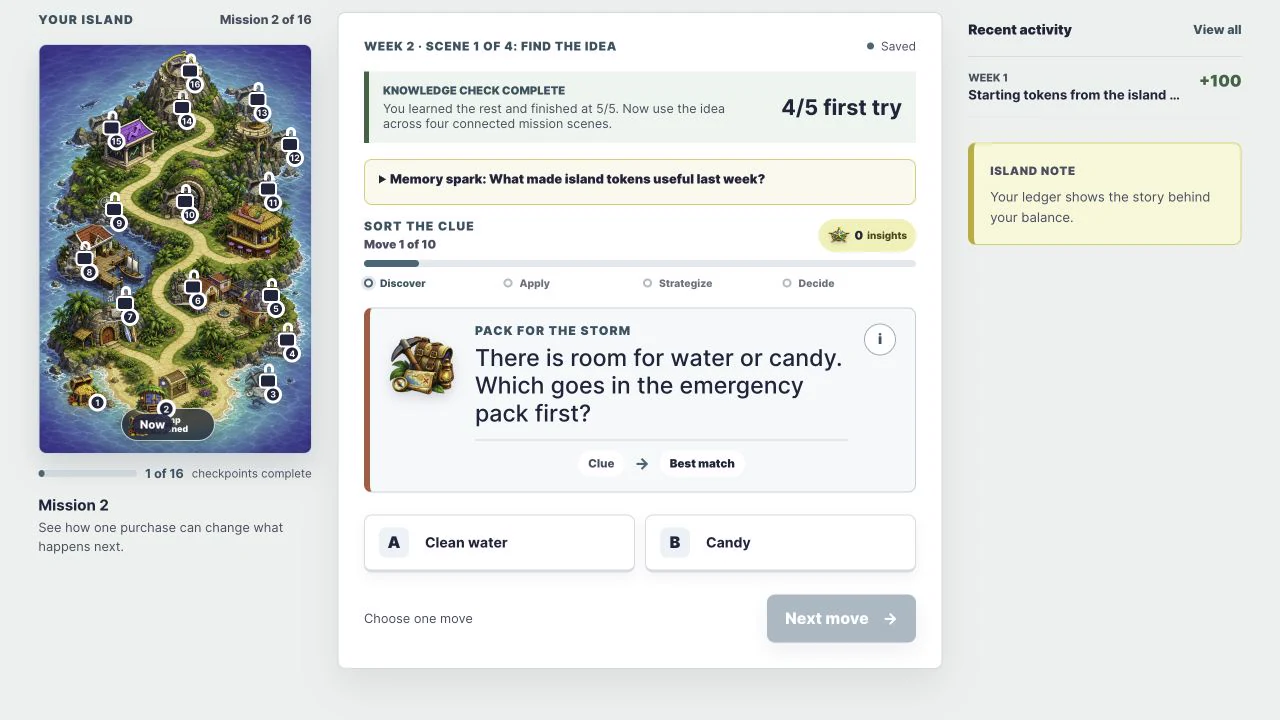
Each module moves through four purposeful moments. Families can follow the connected order, then pause, revisit, or repeat at the learner’s pace.

Current Island Tycoon mission scene connecting an age-appropriate knowledge check to an island decision
One idea becomes a visible choice.Knowledge checks, calculation, ledger work, and consequence carry the learning forward.
  1. 01

    Learn

    Meet one concept in an 8–12 minute, story-driven lesson.

  2. 02

    Check

    Answer a short knowledge check before moving forward.

  3. 03

    Choose

    Compare options, calculate, and commit to an island decision.

  4. 04

    Reflect

    Use the ledger and visible consequence to explain what changed.

Can they compare the options?Can they calculate what remains?Can they record the decision?Can they explain the tradeoff?

Clear by design

Clear education. Clear boundaries.

Youth Finance Academy teaches young people to understand financial concepts and explain decisions. Families can inspect the curriculum, the adult’s role, and the program boundaries before deciding whether it fits.

Learners explore
  • Earning, spending, saving, and tradeoffs
  • Revenue, expenses, profit, and ownership
  • Introductory growth, prices, risk, and diversification
  • How to compare options and explain a decision
The Academy does not provide
  • Brokerage access or live trading rooms
  • Stock picks, alerts, or recommendations
  • Individual financial or investment advice
  • Promises of returns, income, or wealth

Reviewing for a charter or education organization? See program-review details

Your next step

Decide whether Island Tycoon fits your family.

Explore the complete 16-module curriculum for ages 9–11, see the lesson rhythm and included materials, and review the current household access details.